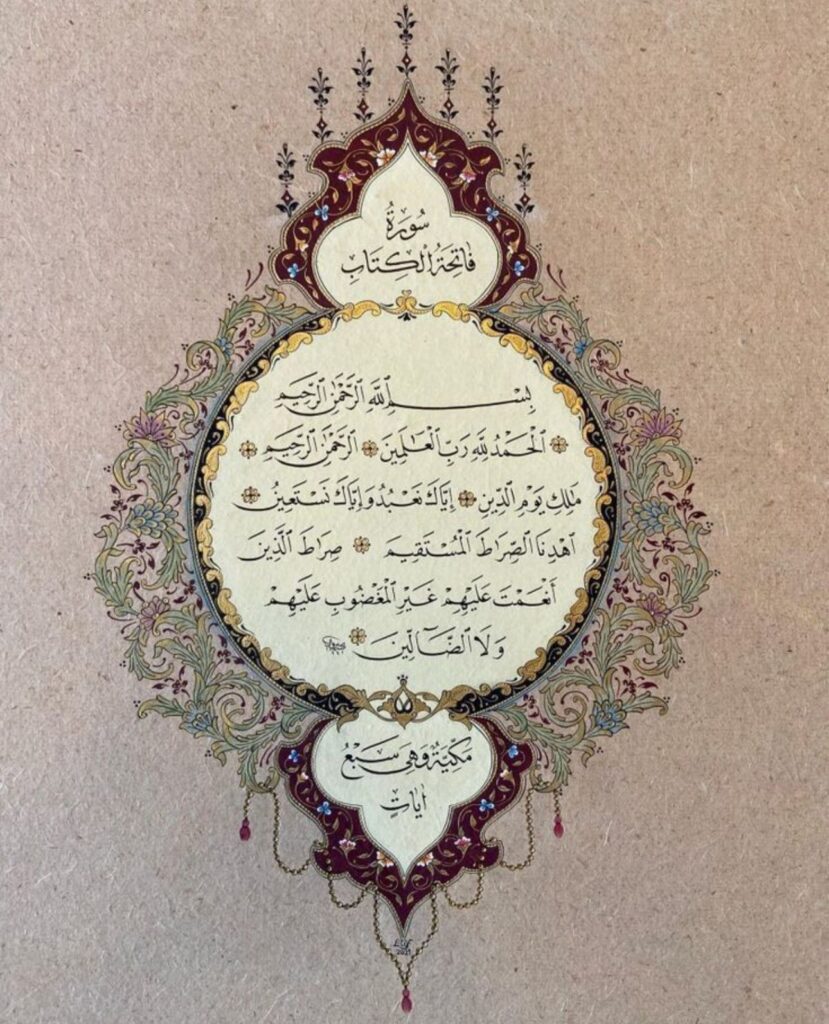
Surah Al-Fatiha is the first chapter of the Qur’an, composed of 7 verses.
It is the foundation of Muslim prayer and theology, often called Umm al-Kitab (“Mother of the Book”).
Context & Importance
• Revealed in Makkah, this Surah summarizes core Islamic beliefs.
• Recited in every unit of Salah (prayer), its understanding is essential.
• It is a supplication and declaration of faith combined.
بِسْمِ اللَّهِ الرَّحْمَنِ الرَّحِيمِ
“In the name of Allah, the Most Compassionate, the Most Merciful.”
• Context: Begins every chapter except one (At-Tawbah).
• Linguistic: Bismillah means invoking Allah’s name before action.
• Scholarly insight: Ibn Kathir explains it calls for seeking Allah’s blessings and mercy in all deeds.
• Theological note: Highlights the dual attribute—Ar-Rahman (universal mercy) and Ar-Rahim (special mercy to believers).
الْحَمْدُ لِلَّهِ رَبِّ الْعَالَمِينَ
“All praise is due to Allah, Lord of the worlds.”
• Context: A declaration of exclusive praise to Allah.
• Linguistic:
Alhamd (الْحَمْدُ) means praise and gratitude.
Rabb (رَبِّ) means Lord, nurturer, sustainer.
Al-‘Alamin (الْعَالَمِينَ) covers all beings—visible and invisible.
• Scholarly insight: Al-Qurtubi notes this affirms monotheism and Allah’s sovereignty.
• Implication: Gratitude for existence and provision belongs solely to Allah.
الرَّحْمَنِ الرَّحِيمِ
“The Most Compassionate, the Most Merciful.”
• Repetition stresses mercy as a defining attribute of Allah (الرَّحْمَنِ الرَّحِيمِ).
• Scholars say it comforts believers, affirming that despite divine justice, mercy prevails.
مَالِكِ يَوْمِ الدِّينِ
“Master of the Day of Judgment.”
L• Context:
Allah is sovereign over the final reckoning.
• Linguistic:
Malik (مَالِكِ) means King, Owner. This signifies that He has possession of the entire affair on the Day of Resurrection.
Yawm ad-Din (يَوْمِ الدِّينِ) is the Day of Resurrection and accounting.
• Scholarly note:
Ibn Kathir emphasizes this verse reminds believers of accountability.
إِيَّاكَ نَعْبُدُ وَإِيَّاكَ نَسْتَعِينُ
“You alone we worship, and You alone we ask for help.”
• Core message:
Exclusive worship and reliance on Allah.
• Scholars:
This verse embodies tawhid (monotheism) and total dependence on God.
• Legal/Theological:
Rejects shirk (associating partners with Allah).
اهْدِنَا الصِّرَاطَ الْمُسْتَقِيمَ
“Guide us to the straight path.”
• Request for guidance:
The ‘straight path’( الصِّرَاطَ الْمُسْتَقِيمَ) means the way of those favored by Allah, avoiding error and deviation.
Guide us (اهْدِنَا)
• Scholarly interpretations:
Al-Tabari explains it’s a supplication for ongoing guidance, not just past favor.
صِرَاطَ الَّذِينَ أَنْعَمْتَ عَلَيْهِمْ غَيْرِ الْمَغْضُوبِ عَلَيْهِمْ وَلَا الضَّالِّينَ
“The path of those You have blessed—not of those who earned Your wrath, nor of those who go astray.”
• Meaning:
Clear differentiation between those rightly guided and those who have deviated.
• Scholars:
The ‘wrath’ refers to the disobedient (often interpreted as Jews in context), and ‘those who go astray’ refers to misguided groups (often Christians).
• Theological nuance:
A prayer to avoid both rebellion and misguidance.
Surah Al-Fatiha encapsulates:
• Absolute monotheism (Tawhid).
• Allah’s mercy and sovereignty.
• Accountability in the Hereafter.
• Total devotion and reliance on God.
• A plea for constant guidance.
Hadith References on Surrah Fatiha
1. Surah Al-Fatiha is the Greatest Surah in the Qur’an
Hadith:
“Shall I not teach you the greatest Surah in the Qur’an?”
The Prophet (ﷺ) said: “It is Al-Hamdu Lillahi Rabbil ‘Alamin” (i.e., Surah Al-Fatiha).
Reference:
Sahih al-Bukhari 4474
2. Surah Al-Fatiha is a Dialogue Between You and Allah
Hadith (Qudsi):
Allah said:
“I have divided the prayer between Myself and My servant into two halves, and My servant shall have what he asks for…”
Then He describes each verse of Surah Al-Fatiha as a conversation:
• “When he says: Al-hamdu lillahi Rabbil-‘alamin, Allah says: My servant has praised Me.”
• …and so on through the whole surah.
Reference:
Sahih Muslim 395
(Book 4, Hadith 771)
3. Surah Al-Fatiha is Required in Every Rak’ah
Hadith:
“Whoever performs a prayer and does not recite the Opening of the Book (Al-Fatiha) in it, his prayer is incomplete…”
He repeated this three times.
Reference:
Sahih Muslim 394 a
(Book 4, Hadith 770)
How Allah Replies
When you say,
الْحَمْدُ لِلَّهِ رَبِّ الْعَٰلَمِينَ (
All praise is for Allah-Lord of all worlds
Allah replies,
“My servant has praised Me”
When you say,
الرَّحْمَنِ الرَّجِيمِ
the Most Compassionate, Most Merciful,
Allah replies,
“My servant has exalted Me”
When you say,
مَٰلِكِ يَوْمِ ٱلدِّينِ
Master of the Day of Judgment.
Allah replies,
“My servant has glorified Me.”
When you say,
إِيَّاكَ نَعْبُدُ وَإِيَّاكَ نَسْتَعِينُ ٥
You alone we worship, and You alone we ask for help.
Allah replies,
“This is between Me and My servant, and My servant shall have what he asks for.”
When you say,
آهْدِنَا الصِّرَاطَ الْمُسْتَقِيمَ
صِرَاطَ ٱلَّذِينَ أَنْعَمْتَ عَلَيْهِمْ غَيْرِ
الْمَغْضُوبِ عَلَيْهِمْ وَلَا الضَّالِينَ (٤
Guide us to the straight path, the path of those whom you have favored, not those who earned wrath and went astray.
Allah replies,
“This is for My servant, and My servant shall have what he asks for”